

Regardless of whether you are just beginning your investment journey or are already seasoned in the field, your ultimate aim is likely to achieve your financial objectives through the stock market. At some point, you may have contemplated the idea of managing your investments independently—also known as the DIY (do-it-yourself) approach. Before moving forward with that choice, I’ll outline your alternatives to ensure you’re well-informed. Furthermore, I’ll demonstrate how simple it can be to transition into a DIY investor.
This article serves as the first installment in a comprehensive six-part series on DIY Investing, which will unfold over the next few months. Drawing on over a decade of experience as a self-directed investor, I will share insights and guidance to help you navigate the path to becoming a DIY investor.
Reasons to Invest in the Stock Market
If you haven’t yet begun investing in the stock market, there are numerous compelling reasons to start now. Should you have savings in a low-interest account that you won’t need to access in the near future, and your emergency fund is sufficiently funded, investing that money could prove advantageous. By doing so, you can earn interest on your capital, accelerating your journey towards financial goals through the effects of compound interest and dividend distribution.
Before diving into investing, it’s crucial to identify your financial objectives. Whether you aim to save for retirement, achieve financial independence, transition away from a 9-to-5 job, or start a family, investing provides a valuable opportunity to enhance your financial standing and build your net worth.
Three Investment Strategies in the Stock Market
Here are three popular methods for getting your feet wet in the world of investing.
Engaging a Financial Advisor
If you come into a significant sum of money, such as an inheritance or if your financial situation is complex, consulting a financial advisor might be beneficial. They can offer tailored investment advice. However, it’s important to ascertain whether they are affiliated with specific financial institutions and that they provide a clear outline of their fees. A fee-only advisor may be preferable if you seek objective guidance.
As the financial advisory sector isn’t entirely standardized (as anyone can claim such a title), it’s wise to verify their credentials to ensure they can meet your needs. Typically, they cater to high-net-worth clients, which can lead to steep fees. Seek recommendations, gather referrals, and interview multiple advisors before selecting one.
Utilizing a Robo Advisor
If you have as little as $1,000 to invest, a robo-advisor is an option. Usually, you’ll fill out a questionnaire that allows an algorithm to assemble your investment portfolio. The fees for this service lie somewhere in the middle: you will incur management expense ratios (MER) for the funds you choose, along with the cost of the robo-advisor’s service. For investors with substantial assets, some robo-advisors may provide the option of human advisory services. This choice suits individuals who prefer a less hands-on approach while avoiding higher fees associated with traditional financial advisors.
DIY Investing
Choosing to become a self-directed investor can be an ideal path for those who have a solid grasp of investing fundamentals and wish to maintain complete control over their portfolios while minimizing fees. It’s vital to keep emotions out of your decision-making process, as your success is contingent on your ability to make well-informed choices.
If you’re interested in a discount brokerage that allows you to invest at lower costs, consider opening an account with Qtrade Direct Investing, which currently offers up to $150 in bonus cash.
Understanding Compound Interest
Think back to your childhood when you rolled a large snowball: early on, it requires effort to get it rolling, but as it grows, it becomes easier to manipulate. This analogy similarly applies to compound interest in the investment world.
Initially, as you invest small sums, your portfolio may grow sluggishly. Eventually, however, it can accelerate, with your earnings compounding over time.
For instance, if you invest $6,500 annually (the current limit for TFSA contributions) at an annual interest rate of 6%, after ten years, your investment could grow to $85,675.17. In total, you will have contributed $65,000 and earned $20,675.17 in interest. This phenomenon is why Warren Buffett referred to compound interest as “the eighth wonder of the world.”
| Year | Total Investment | Yearly Interest | Total Interest | Total Value |
|---|---|---|---|---|
| 1 | $6,500 | $0 | $0 | $6,500 |
| 2 | $13,000 | $390 | $390 | $13,390 |
| 3 | $19,500 | $803.40 | $1,193.40 | $20,693.40 |
| 4 | $26,000 | $1,241.60 | $2,435 | $28,435 |
| 5 | $32,500 | $1,706.10 | $4,141.10 | $36,641.10 |
| 6 | $39,000 | $2,198.47 | $6,339.57 | $45,339.57 |
| 7 | $45,500 | $2,720.37 | $9,050.94 | $54,559.94 |
| 8 | $52,000 | $3,273.60 | $12,333.54 | $64,333.54 |
| 9 | $58,500 | $3,860.01 | $16,193.55 | $74,693.55 |
| 10 | $65,000 | $4,481.62 | $20,675.17 | $85,675.17 |
The Impact of Compound Interest on Your Portfolio Growth
Below is a comparison chart demonstrating how your investments can grow annually based on specified monthly contributions and different annual interest rates.
Note: The information provided here is for illustration only and does not guarantee any outcomes, as investing inherently carries risks.
| Monthly Contribution | 40 Years @ 4% Interest | 40 Years @ 6% Interest | 40 Years @ 8% Interest |
|---|---|---|---|
| $100 | $116,106.38 | $190,767.78 | $322,107.93 |
| $500 | $580,531.88 | $953,838.88 | $1,610,539.67 |
| $1,000 | $1,161,063.76 | $1,907,677.76 | $3,221,079.35 |
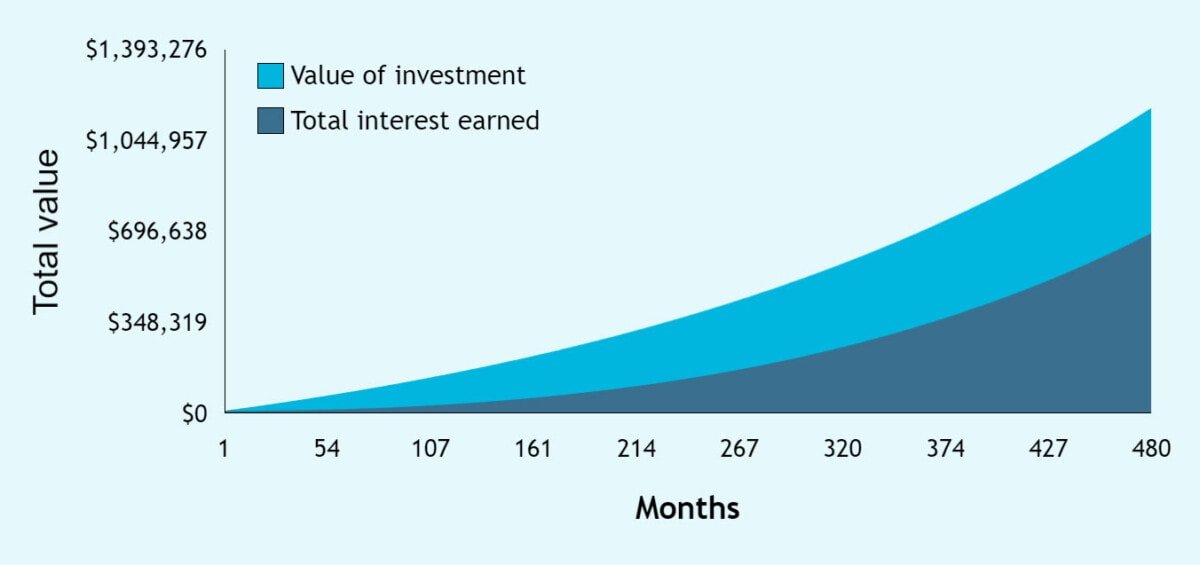
In the visualization above, a monthly investment of $100 at an annual interest rate of 4% would grow to approximately $116K over 40 years through the power of compounding.
Increasing your contribution to $500 at a 6% interest rate could yield $953K after four decades. For the larger investors, allocating $1,000 monthly at an 8% interest rate can potentially grow your wealth to around $3.2 million after the same time span.
To explore how your investments might grow, utilize this compound interest calculator and input your specific figures. This illustrates that the longer your investment horizon, the more effective the impact of compound interest becomes!
Advantages of Transitioning to DIY Investing
It’s easy to hesitate and delay making changes in our lives. Nevertheless, the financial benefits of eliminating unnecessary fees can serve as a decisive factor for many in opting for self-directed investing. If you prefer to select your investments independently, that is another excellent justification to take the leap.
When I transitioned my investments from mutual funds held at a major bank to an online brokerage, it merely required some time to complete the necessary paperwork and submit it. Although that was over ten years ago, advancements in technology have significantly simplified the process.
These days, you can complete all forms online to speed up the processing. After establishing an account with your new online brokerage, the next step is to transfer your assets from your current RRSP or TFSA.
There are various methods for moving your funds. The easiest is filling out the transfer form and indicating a transfer in-kind, which allows for a straightforward transfer of your holdings to the new brokerage. While you may need to wait several weeks, patience is advised. Once the transfer is complete, you can immediately begin managing your investment portfolio while saving on fees.
It’s Time to Make the Move and Begin
Switching to DIY investing offers numerous advantages, including lowering your fees and gaining control over investment decisions. For those transitioning from financial or robo advisors to an online brokerage, you may have your work cut out. If you’re committed to learning—an impetus for your reading this piece—you’ll soon experience the rewards of becoming a self-directed investor.
It is important to keep in mind that you don’t need to possess exhaustive knowledge about investing—merely a foundational understanding to get started.
You’ll always have opportunities to refine your approach as you grow more experienced. Today’s landscape offers a plethora of options compared to a decade ago, indicating that the sooner you begin, the better positioned you’ll be to leverage the benefits of compound interest.
In the next installment of this DIY Investing series, we will explore understanding your unique investor personality type.