

Are you seeking a reliable Turo review from someone who has firsthand experience with the platform? Do you have a vehicle that tends to remain idle in your driveway and you’d like to earn some extra income? Or perhaps you’re in need of a vehicle that’s more accessible than traditional car rental options.
Allow me to introduce you to Turo, a fresh and straightforward method for Canadians to generate income and secure vehicles. Often compared to “Airbnb for cars,” Turo is a peer-to-peer car-sharing service that has recently captured significant attention. In this evaluation, I will explain how you can transform that unused vehicle into a constant income source without leaving your home. For those looking to rent, I will also discuss why Turo outshines conventional car rental companies. Intrigued? Let’s explore further.
What is Turo?
So what exactly is Turo? As mentioned previously, you can think of it as the Airbnb for vehicles. Instead of renting your home to strangers, you rent your car. Turo began in the USA and has been operating in Canada since 2016, starting in Ontario, Alberta, and Quebec and subsequently expanding to Nova Scotia and British Columbia. Over a million Canadians have registered with Turo since its launch, and there are now over 44,000 cars listed across 370 cities in Canada, as well as operations in the USA and UK.
Similar to Airbnb, those searching for a car can filter based on specific features or models. You might be interested in luxurious options for a weekend retreat, pet-friendly cars for traveling with furry companions, or all-wheel-drive vehicles for off-grid excursions. Each host has a profile displaying their available vehicles along with customer reviews. Hosts can feel secure knowing that Turo screens guests, and the choice to accept or decline a booking is entirely up to them.
How does Turo work (for guests)
How does Turo actually function? As a guest (the renter), you will need to create an account online or through the Turo app and verify your eligibility as a driver (the verification process may take up to 24 hours). Once verified, you can begin browsing available vehicles.
Being a peer-to-peer car-sharing platform, you have the option to search via an integrated map or apply various filters such as price, car type, brand, etc. The selection is significantly broader compared to traditional car rental agencies, and the level of convenience and customer service is typically superior.
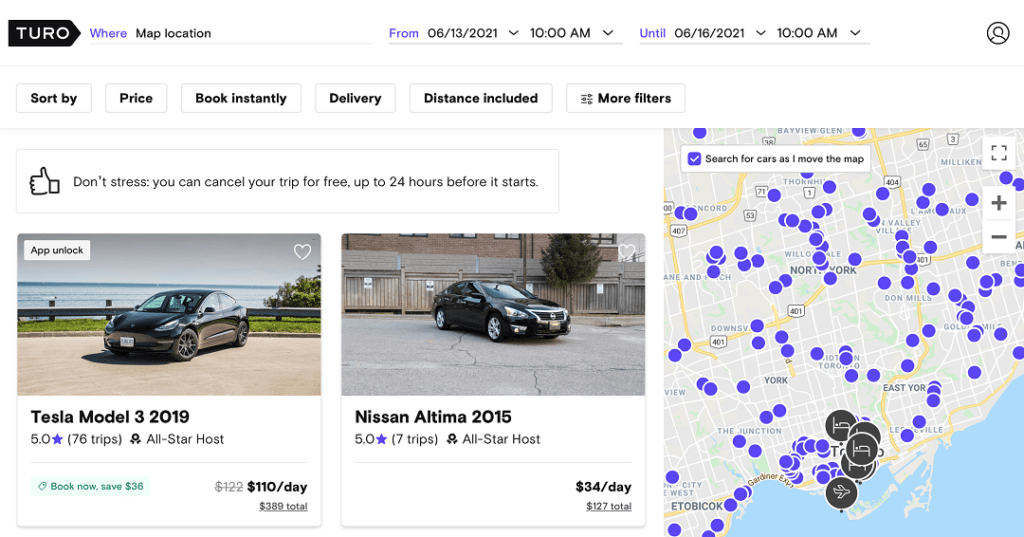
Once you’ve found a car you like, you can view the host’s profile for additional details and reviews. If everything looks satisfactory, you can proceed to request a booking. While most requests are instantly confirmed, some may require host approval.
If you’re new to Turo, the host will guide you through the pickup process. Many have adopted contactless methods, enabling you to avoid direct interaction. However, you will need to provide identification (or a selfie with your ID if opting for contactless) during pickup.
Normally, a full tank of gas is provided with the car, and you’re expected to return it in the same condition. If you neglect to refuel, the host will do so and charge you afterward. To prevent fraud, hosts document everything, including the vehicle’s mileage, during both pickup and drop-off. Additionally, you may have the option for the car to be delivered to your location, though this incurs an additional fee.
If your plans change, there’s no need to stress. You can cancel your booking for free up to 24 hours before your scheduled time. If everything remains on track, you’ll either collect the car directly from the host or have it delivered, as previously arranged. Depending on your location, you also have the option to rent a ‘Turo-Go’ vehicle, which can be unlocked through the app. Once you are behind the wheel, you’re off on your adventure!
How does Turo work (for hosts)
If you’ve read this far in my Turo review, you’re likely interested in earning extra income as a host. The good news is that Turo makes it easy to get started.
You begin by setting up an account on Turo.com. It’s free and quick to do. The process involves:
- Listing your vehicle(s) – you can register more than one
- Choosing your availability and pricing
- Renting out your vehicle(s)
- Getting paid
Simple, right?
While crafting your profile, you’ll need to specify your vehicle’s make and model and upload several images. Ensure that your vehicle meets the eligibility criteria, which includes universal and Canada-specific requirements. For instance, in Canada, the car should not be older than 12 years. More details on requirements can be found in Turo’s guidelines.
Regarding pricing, you can set your own or opt for automatic pricing, which Turo calculates based on demand and price trends. Furthermore, Turo has a vetting system for guests. When they register, guests provide personal information, and Turo checks their insurance history to approve only those with good driving records.
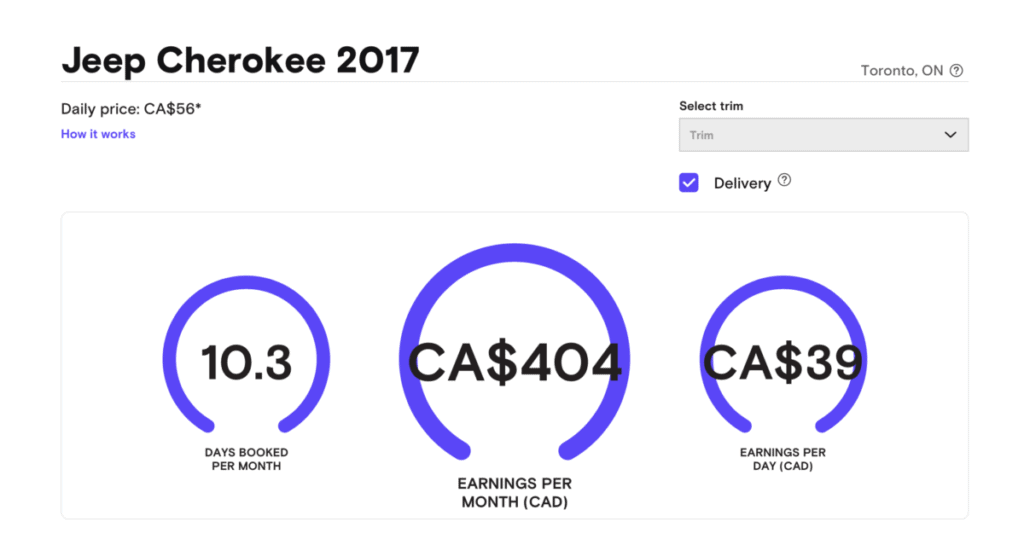
As a host, you have considerable flexibility. You can block out times for personal use or manage multiple cars. Some hosts even maintain a fleet and rent out parking spaces in busy areas to boost their income.
You’re likely curious about earnings. According to Turo, small business hosts can expect to earn an average of $9,337 CAD annually from one car, $28,010 CAD from three cars, $46,684 CAD from five cars, and $84,031 CAD from nine cars listed.
That’s pretty impressive for a vehicle that might otherwise just collect dust in your driveway! Many hosts find Turo to be a worthwhile venture, and it can even evolve into a small business.
Turo insurance
Naturally, one of the primary concerns with car-sharing services is insurance. Here’s an overview of how Turo handles insurance for hosts and guests.
For Hosts
Turo offers insurance coverage for hosts in the eligible Canadian provinces where it operates (Ontario, Alberta, Quebec, Nova Scotia, and British Columbia). Coverage in Canada is provided by Intact Financial Corporation and includes $2,000,000 in liability protection and physical damage coverage (up to $105,000).
If you’re outside these provinces or opt not to use Turo’s insurance, you can still become a commercial host, but you will waive all protection from Turo. Remember that even if your personal insurance won’t be used by Turo, you must inform your insurer and get their approval to participate in a peer-to-peer car-sharing program; otherwise, your personal policy could be voided.
For Guests
Now, let’s address the insurance options available for guests. Guests can choose from four different plans based on the deductible (maximum out-of-pocket cost):
- Premier plan: Maximum coverage with a $0 deductible
- Standard plan: $500 deductible
- Minimum plan: $2,000 deductible
- Decline plan
All plans provide a $2,000,000 third-party liability policy, regardless of whether guests choose to decline protection. Full information is accessible through Turo’s site.
Each plan includes this liability coverage provided by Intact or ICBC (in British Columbia), protecting you if you’re involved in an accident and face a lawsuit. Guests also benefit from included roadside assistance to help in case of emergencies.
How much does Turo take?
What does it cost to be a host? Fortunately, there are no sign-up fees or monthly costs. You may wonder: how does Turo make its money?
Turo retains a portion of each booking fee, which varies based on the Turo plan chosen. Under the standard plan, there is a 70/30 split, with you receiving 70% and Turo taking 30%. Although this may seem substantial, it’s actually a better deal than Lyft or Uber when considering guests also cover your gas and the excellent insurance coverage you receive.
Keep in mind, you set your daily rates and can establish discounts or delivery costs (within Turo’s guidelines). Any incidental fees (like tolls, cleaning, or smoking fees) are yours at 100%, while for extras, you’ll keep 90% of those costs. Furthermore, for additional mileage or late returns, your compensation will depend on the protection plan you’ve selected.
Is Turo cheaper than car rental agencies?
This really varies based on your situation. For a standard economy vehicle, traditional car rental agencies may offer lower prices. This can be a drawback for some, as highlighted in this Turo review. However, for luxury vehicles or specific models, Turo frequently comes in cheaper. It’s vital to remember that while cost is important, convenience and customer service should also play a significant role in your decision-making process.
With Turo, you can conveniently search for a car rental nearby, whether at home or during your travels. Traditional agencies often require you to travel to the airport or designated pickup locations, which can be inconvenient. Also, with rental agencies, you usually don’t know the exact model you will receive. In contrast, with Turo, you can specifically select the vehicle that suits your needs, whether it’s a rugged jeep for camping or a convertible for a coastal drive.
Pros and cons of Turo
No service is without its drawbacks, so it’s essential to weigh whether the benefits surpass the issues. Here’s a breakdown of the primary pros and cons of Turo for both guests and hosts.
Pros
- Effortlessly generate income with minimal effort required
- Flexibility in terms of scheduling and pricing
- No fixed monthly fees
- Comprehensive insurance and liability coverage
- More convenient than traditional car rental services
- Free cancellation possible within 24 hours of pickup
Cons
- A number of eligibility requirements must be met to qualify as a host
- Booking frequency largely depends on your local market; more competition exists in larger cities
- Exclusivity policy in place which prevents listings on other car-sharing platforms
- Trust is essential as you are lending your vehicle to strangers, and not all guests may treat it with respect
- Service limited to five provinces in Canada
Is Turo legit?
Absolutely, Turo is a legitimate service. A quick search online will yield numerous user reviews on sites like Consumer Affairs, the Better Business Bureau, and Trust Pilot. As of the date of this article, Turo enjoys positive ratings, averaging around 4 out of 5 stars or higher across various platforms.
Turo utilizes several verification processes to help prevent fraud. Not only must you provide personal information, including a driver’s license, at registration, but you’ll also have to present identification again during pickup, ensuring safety for both hosts and guests.
Turo customer service
Providing 24/7 roadside assistance and active customer support all week long, Turo ensures that both guests and hosts have access to online chat support for any issues they may encounter.
For roadside help, you can call these toll-free numbers:
- In the United States, call 1.415.965.4525
- In Canada, call 1.888.391.0460
- In the UK, call 0344.243.8660
Is Turo worth it?
So, is Turo a worthwhile endeavor? That ultimately hinges on your personal circumstances and your comfort level with sharing your vehicle with others. Turo has proven to be a legitimate platform, and for anyone considering a side hustle, this option is tough to beat. If you require quick access to a vehicle, Turo could be the solution you’re looking for.