

**This article is brought to you by BMO ETFs.
Have you ever found yourself wondering, “I want to start investing, but how do I start?” It’s normal to feel daunted by the vast array of terms, abbreviations, and the elusive “ticker symbols” (yes, the ones representing ETFs). Deciding what to invest in, determining the appropriate asset allocation, and knowing when to adjust your holdings can leave even the most detail-oriented individuals feeling hesitant.
Here’s some reassuring news: investing doesn’t have to be a source of anxiety. BMO’s Asset Allocation ETFs are crafted to streamline the investing process, presenting a complete solution that helps balance your investment portfolio without unnecessary stress and uncertainty.
What Are Asset Allocation ETFs?
Asset allocation ETFs comprise a portfolio with a predefined blend of assets. This mixture typically includes various asset classes, such as fixed income and equities, spanning different indexes, sectors, and regions. Rather than manually adjusting and rebalancing your portfolio, these ETFs are programmed to automatically rebalance, ensuring that your allocative strategy remains intact at a low cost.
For instance, the BMO All-Equity ETF (ZEQT) emphasizes growth with a greater focus on equities, while the BMO Conservative ETF (ZCON) adopts a cautious stance with a heavier allocation to fixed income assets. This adaptability allows investors at various life stages—from novices to those approaching retirement—to find an option that aligns with their financial objectives.
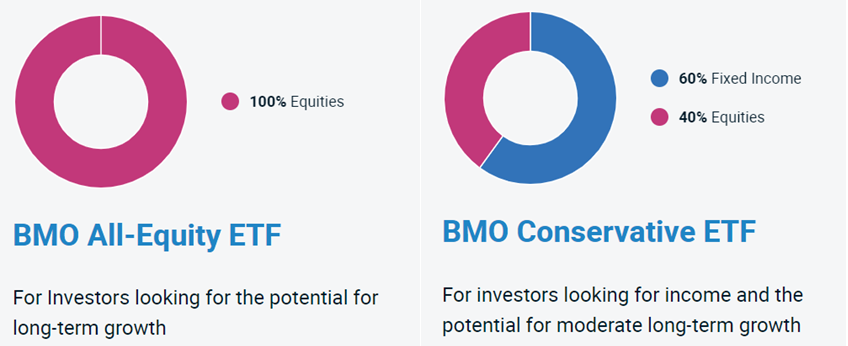
Asset allocation ETFs serve as a comprehensive solution for individuals seeking diverse investment options, tailored to their specific objectives and asset preferences.
The Rise of Asset Allocation ETFs: Addressing Investor Needs
To appreciate the significance and appeal of asset allocation ETFs, it is helpful to consider their origins. These valuable tools arose from the common challenges faced by investors striving to manage diversified portfolios while adhering to their desired asset allocations.
Picture an investor in the early 2000s juggling a mix of individual stocks, bonds, and perhaps mutual funds. Each year, they needed to assess their portfolio and recalibrate the weightings to meet their shifting objectives, while also keeping tax impacts, trading expenses, and time limitations in mind. This process was not only labor-intensive but left plenty of room for mistakes—sometimes resulting in portfolios that were biased toward particular sectors or geographies.
The financial downturn of 2008 underscored the critical need for improved portfolio management techniques. Investors who had not adequately diversified or rebalanced experienced drastic losses, while those with more disciplined strategies fared better.
In response to these challenges, ETF providers like BMO recognized an opportunity to develop a product that simplified the investment journey. The approach was straightforward yet impactful: devise an all-in-one ETF that provided diversification, automatic rebalancing, and cost-efficiency. By utilizing ETFs as foundational assets, these providers could extend exposure to international markets and various asset categories at a fraction of the cost of traditional mutual funds. This innovation gave rise to asset allocation ETFs.
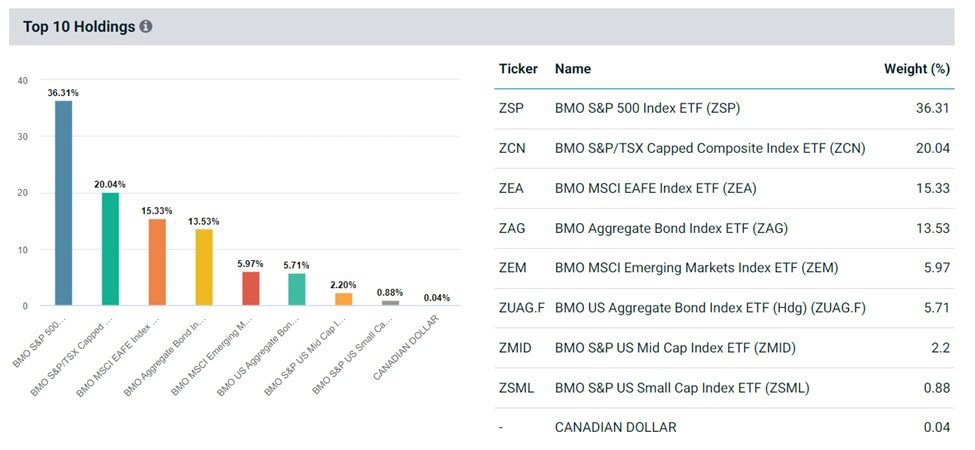
Source: BMO Global Asset Management, BMO Growth ETF (ZGRO:TSX), as of September 18th, 2024.
The portfolio holdings may change without warning and only represent a fraction of the total assets. They should not be viewed as endorsements for any specific security.
Why Is the Mix Important?
The renowned Brinson, Hood, and Beebower (BHB) research from 1986 indicated that over 90% of the variance in a portfolio’s performance can be attributed to asset allocation, not to stock selection or market timing.

This finding transformed investor strategies, highlighting the vital role of diversification across asset classes for long-term success. Most modern asset allocation ETFs, and investment funds in general, are constructed following this principle. This supports the idea that asset allocation, rather than picking individual stocks or timing the market, drives the success of long-term investments—ideal for those wanting a low-maintenance “couch-potato” approach to wealth accumulation.
Benefits of Asset Allocation ETFs
Simplicity and Ease
Asset allocation ETFs handle most of the complicated aspects for you. Thanks to automatic rebalancing and inherent diversification, they provide a simplistic investment strategy.
Diversification
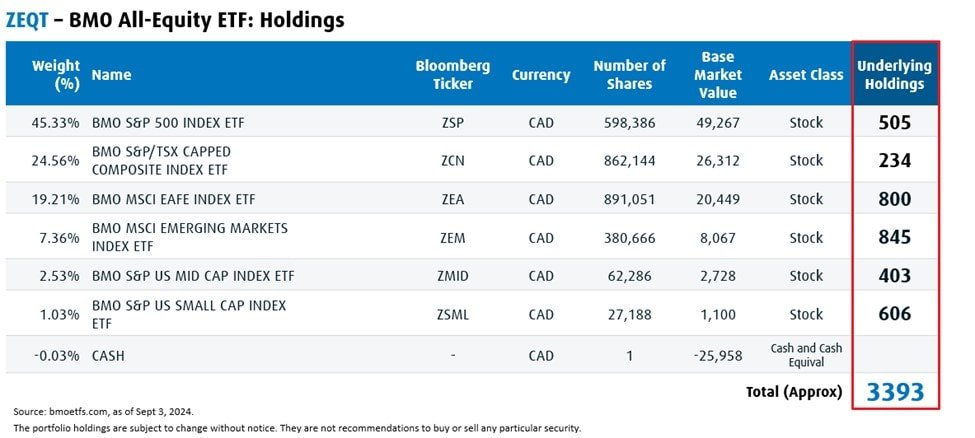
These ETFs grant exposure to a diverse range of global stocks, ensuring you have ample diversification across various sectors and regions, regardless of whether your preference is conservative, growth-focused, or something in between.
Cost Efficiency
A significant advantage of ETFs is their cost efficiency, and BMO’s asset allocation ETFs exemplify this. Moreover, with fewer transactions needed for maintaining the portfolio, investors can sidestep high trading fees.
Long-Term Orientation
BMO’s asset allocation ETFs are structured for long-term investors, making them suitable for those intent on wealth growth. By maintaining a consistent asset mix and rebalancing periodically, these ETFs help mitigate emotional decisions that can lead to buying at peaks and selling at lows.
The T Series: Customized for Retirees
One of the more recent developments in BMO’s asset allocation ETF offerings is the T series1, which is specifically tailored for retirees or individuals close to retirement. Retirees frequently grapple with generating viable cash flow from their investments while reducing the risk of depleting their funds. The T series addresses this challenge by providing a systematic withdrawal plan that ensures monthly cash flow, aiding smoother retirement planning.
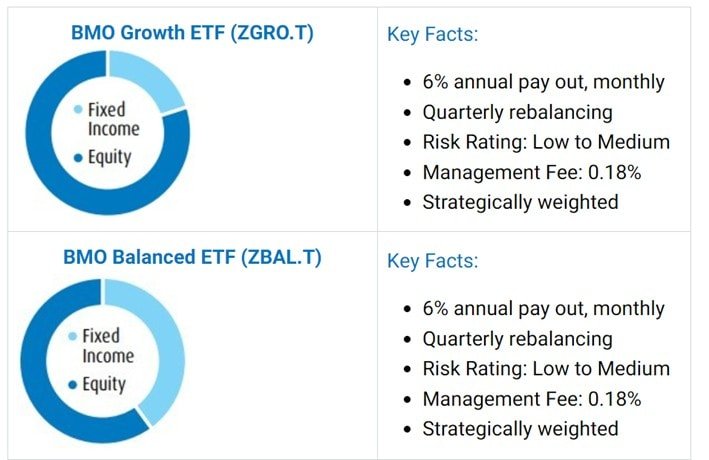
For example, the BMO Balanced ETF (T6 Series) (ZBAL.T) belongs to the T series and aims to generate consistent cash flow through a balanced investment in equities and bonds. This fund offers fixed monthly distributions (6% annualized)2 that comprise a mix of income and return of capital, which is particularly beneficial for retirees.
Conclusion
BMO Asset Allocation ETFs present a straightforward, diverse, and economically wise solution for investors throughout their life stages. Whether you’re beginning your investment journey, seeking consistent growth, or preparing for retirement, these ETFs provide an ideal combination of convenience and financial reassurance. The T series, specifically, offers retirees the advantage of reliable cash flow, simplifying withdrawal management during retirement.
With BMO’s asset allocation ETFs, investors can move forward with assurance about their financial futures, confident that they have chosen a product that aligns with their long-term goals and provides peace of mind amid fluctuating market conditions.
For further insights, visit BMO Global Asset Management to obtain more information.
1 T series – This category comprises Fixed Percentage Distribution Units that guarantee a fixed monthly distribution determined by an annual rate of 6%. These distributions might be composed of net income, net realized capital gains, and/or returns of capital. The monthly amount is calculated based on the annual distribution rate of the T Series Fund’s unit price at the close of the preceding calendar year, resulting in an annual figure per unit for the upcoming year. This total is divided into 12 equal payments distributed monthly.
2 Standardized Performance: ZBAL.T, BMO Balanced ETF (T6 Series) 1 Year: 15.91%, Since Inception: 5.96% as of August 30, 2024.
ZGRO.T, BMO Growth ETF (T6 Series) 1 Year: 18.78%, Since Inception: 14.61% as of August 30, 2024.
Important Disclaimer:
This content has been sponsored by BMO ETFs.
All investments carry risks. The value of an ETF can fluctuate, and you may incur losses. ETFs are rated for risk based on their return volatility as mandated by Canadian Securities Administrators. Historical volatility does not predict future ETF volatility. An ETF with a ‘low’ risk rating can still incur losses. For detailed risk ratings and the specific risks that may influence ETF returns, refer to the BMO ETFs prospectus.
This article is intended solely for informational purposes. The content should not be interpreted as investment, tax, or legal advice. Individual investment strategies should be reviewed based on personal objectives, and professional consultation is advised for any specific circumstances.
Views expressed by the author reflect their market assessment at the time of writing and may change without notice. This content does not constitute a solicitation of an offer to buy or sell securities, nor should it be relied upon as investment advice. Past performance does not guarantee future results. This communication serves informational purposes only.
Any statements dependent on future events are considered forward-looking and are not guarantees of performance. They entail risks, uncertainties, and assumptions. Although such statements are rooted in logical assumptions, actual results may deviate significantly from expectations. Investors should be cautious not to excessively rely on any forward-looking statements and should take into account potential risks outlined in the latest prospectus.
Yield calculations for distributions are based on the latest regular or anticipated distributions, which may include income, dividends, return of capital, and option premiums, while excluding additional year-end or special reinvested distributions. The yield does not extend to reinvested distributions. Distributions are not guaranteed, and are subject to fluctuations and modifications. Distribution rates may change without notice based on market conditions and NAV variations. Payments should not be conflated with the ETF’s overall performance or return. Should distributions exceed the fund’s performance, the investment value may decline. Tax obligations will apply to distributions received as a result of investments, with adjustments to the adjusted cost base based on capital returns possibly incurring capital gains taxes if the adjusted basis falls below zero.
Cash distributions, if applicable, for BMO ETF units (excluding accumulating units or those part of a distribution reinvestment plan) are typically derived from dividends, distributions, and other income or gains received by the ETF, less its expenses, but may also include non-taxable returns of capital applied at the manager’s discretion. If the ETF’s expenses exceed its generated income in any month, quarter, or year, distributions may not be feasible. In the case of accumulating units of specific BMO ETFs, distributions will be automatically reinvested into additional accumulating units. Post-distribution, the number of outstanding accumulating units will be consolidated to match their quantity before the distribution. Non-resident unitholders may encounter shareholder reductions due to applicable withholding taxes. Certain BMO ETFs feature a distribution reinvestment plan, allowing unitholders to automatically reinvest cash distributions in additional units as per the plan’s terms. For more details, consult the distribution policy in the BMO ETFs prospectus.
Index returns do not factor in transaction costs or the deduction of fees and expenses, and investing directly in an Index is not possible. Historical performance might not mirror future results.
The Index referenced herein is produced by S&P Dow Jones Indices LLC or its affiliates (“SPDJI”), and is licensed for managerial use. S&P®, S&P 500®, US 500, The 500, iBoxx®, iTraxx®, and CDX® are trademarks of S&P Global, Inc. or its affiliates (“S&P”) while Dow Jones® is a registered trademark of Dow Jones Trademark Holdings LLC (“Dow Jones”), and these trademarks have been licensed for usage by SPDJI and sublicensed for specific purposes by the Manager. The ETF is not endorsed, sponsored, sold, or promoted by SPDJI, Dow Jones, S&P, or affiliates, nor do they guarantee the advisability of investing in the mentioned products or take accountability for any errors or interruptions of the Index.
The ETF discussed in this article is not advocated, endorsed, or promoted by MSCI, which holds no liability regarding the ETF or any related index. The ETF’s prospectus breaks down the limited association MSCI has with the Manager and related ETFs.
Investing in exchange-traded funds incurs commissions, management fees, and other expenses. Prior to investing, please read the ETF Facts or prospectus for the BMO ETFs. The reported rates of return reflect historical annual compounded total returns, accounting for unit value changes and the reinvestment of all dividends or distributions while excluding all sales, redemptions, distributions, optional charges, or income taxes due from any unitholder, which could potentially diminish returns. ETFs are not guaranteed, and their values are subject to fluctuations; historical performance is not indicative of future outcomes.
For a concise overview of the risks related to investing in BMO ETFs, please review the specific risks outlined in the BMO ETF’s prospectus. BMO ETFs are traded like stocks, can fluctuate in value, and may trade at a discount to their net asset value, increasing the risk of losses. Distributions are not guaranteed and may change or be eliminated.
BMO ETFs are managed by BMO Asset Management Inc., an investment fund manager and portfolio manager, operating as a separate legal entity from the Bank of Montreal.
BMO Global Asset Management operates as a brand name for BMO Asset Management Inc. and BMO Investments Inc.
“BMO (M-bar roundel symbol)” is a trademark of Bank of Montreal, licensed for use.