

Are you searching for stock recommendations? Wondering how to begin navigating the markets? Seeking reliable research?
As Canadians, we face limited choices when it comes to investment services.
With that in mind, I decided to review one of Canada’s top investment platforms, in addition to one of the fastest-growing services recently: Motley Fool and Stock Trades Premium.
Both The Motley Fool and Stock Trades offer a Premium subscription model, allowing investors to sign up for an annual fee. Are these investment services worth the investment?
Let’s examine these two prominent Canadian investment platforms, as their distinct features make them unique.
We’ll begin with the fundamentals—specifically, website usability—before diving deeper into each platform.
Stock Advisor Canada vs. Stock Trades Premium Review
When comparing Stock Advisor Canada and Stock Trades Premium, it’s evident that both platforms cater to Canadian investors looking to build a portfolio or enhance the performance of their existing investments.
Stock Advisor Canada emphasizes both Canadian and U.S. equities, whereas Stock Trades Premium specifically focuses on stocks within the Toronto Stock Exchange. This exclusive approach has quickly garnered appreciation over the last two years.
Website Navigation
In any online service, user-friendliness and navigation are critical. Upon logging in, users encounter distinctly different dashboards.
At first glance, Stock Trades presents a modern and sleek interface that is intuitive and easy to explore. Users can quickly access all key information on the Dashboard and stay updated on recent announcements.
Conversely, The Fool’s dashboard resembles a conventional blogging site. While not necessarily inferior, it comes across as outdated, requiring users to search extensively for information.
Outside of the Dashboard design, navigation across both platforms is straightforward.
If I had to recommend a more efficient website, Stock Trades clearly stands out.
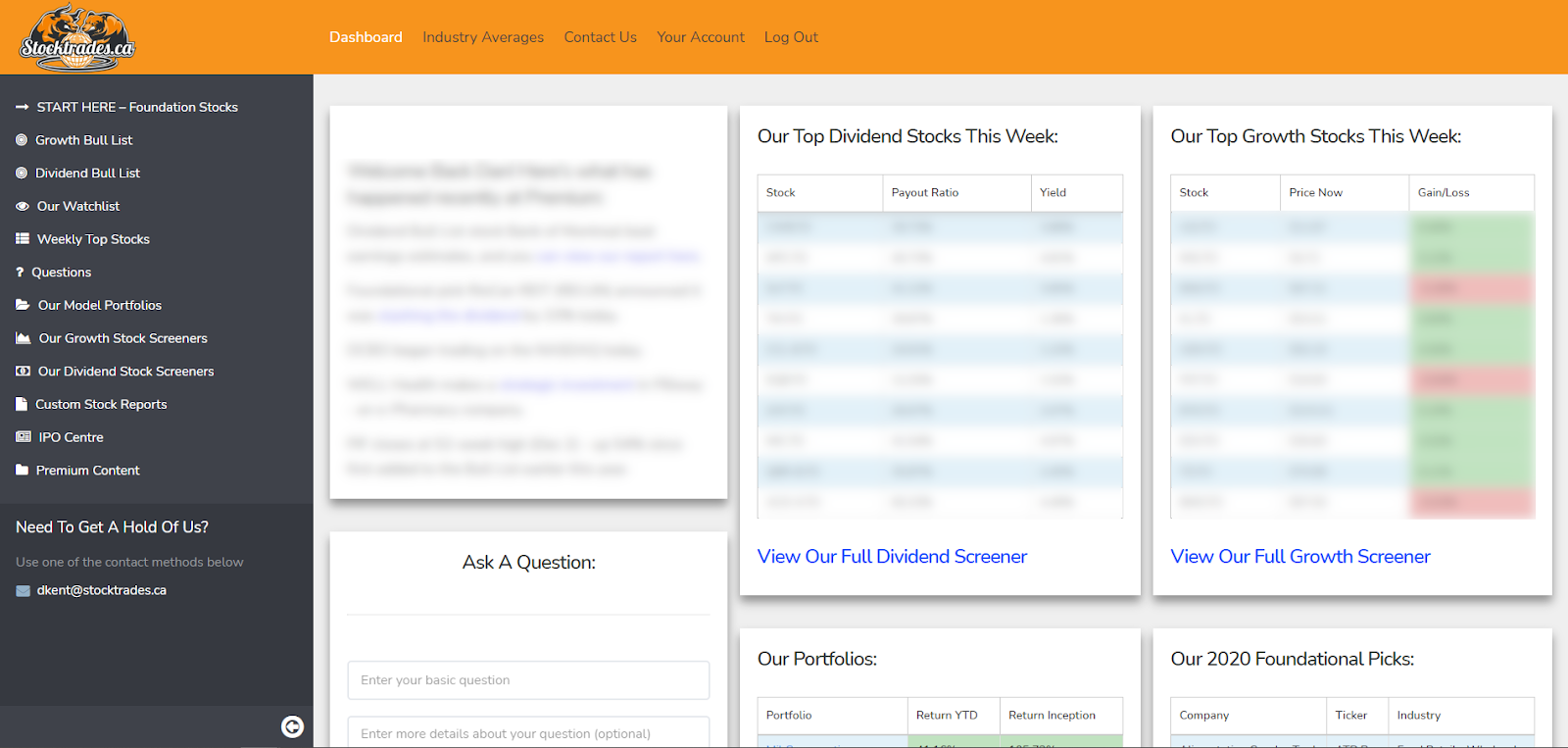
Verdict: Stock Trades has a slight advantage over The Fool, attributed to its contemporary design and informative Dashboard.
Similar Features
Next, let’s delve into what each service provides. Despite their differences, these platforms share several core similarities.
Beginner Stocks
Both platforms feature a selection of stocks designed for novice investors. These picks serve as robust options for those new to investing. Stock Trades refers to their annual top 10 as “Foundational Stocks,” while Motley Fool does not have a specific title for their offerings.
Out of respect for their research, I won’t critique the specific stock selections—they have been well-researched and presented on both platforms.
Neither service tracks the performance of their beginner stocks, although Stock Trades Premium has indicated that they will begin annual tracking of returns.
Verdict: Tie—there are no distinguishing features in this category.
Top Picks
As an investor, you naturally look for premium stock selections. While the expectation is straightforward, the presentation and details of these choices differ significantly.
The Motley Fool’s “Recommendations”
The Fool supplies one Canadian and one U.S. recommendation each month.
However, a significant drawback lies in the clarity surrounding these recommendations.
I found it unclear whether each stock pick was still a buy. They have made efforts to organize their list better through categorization, but the experience remained somewhat overwhelming.
Moreover, once a stock is recommended, consistent updates are lacking.
Upon reviewing the list, many stocks had not been updated since their initial recommendation. In certain instances, more than a year had elapsed since the last update.
For someone seek guidance on purchasing stocks, relying on outdated reports does not instill confidence.
Overall, navigating The Fool’s list can be challenging, where members often discuss past recommendations in forums to confirm their validity.
Additionally, reports are presented in a blog-like format. While quality is good, organizational consistency varies by company.
At times, this may be overwhelming for novice investors. It’s also uncertain how they generate their picks; the approach seems to combine growth, value, and income strategies.
They maintain a record of historical picks and display cumulative returns, alongside comparisons against the TSX Index.
Stock Trades’ “Bull List” Picks
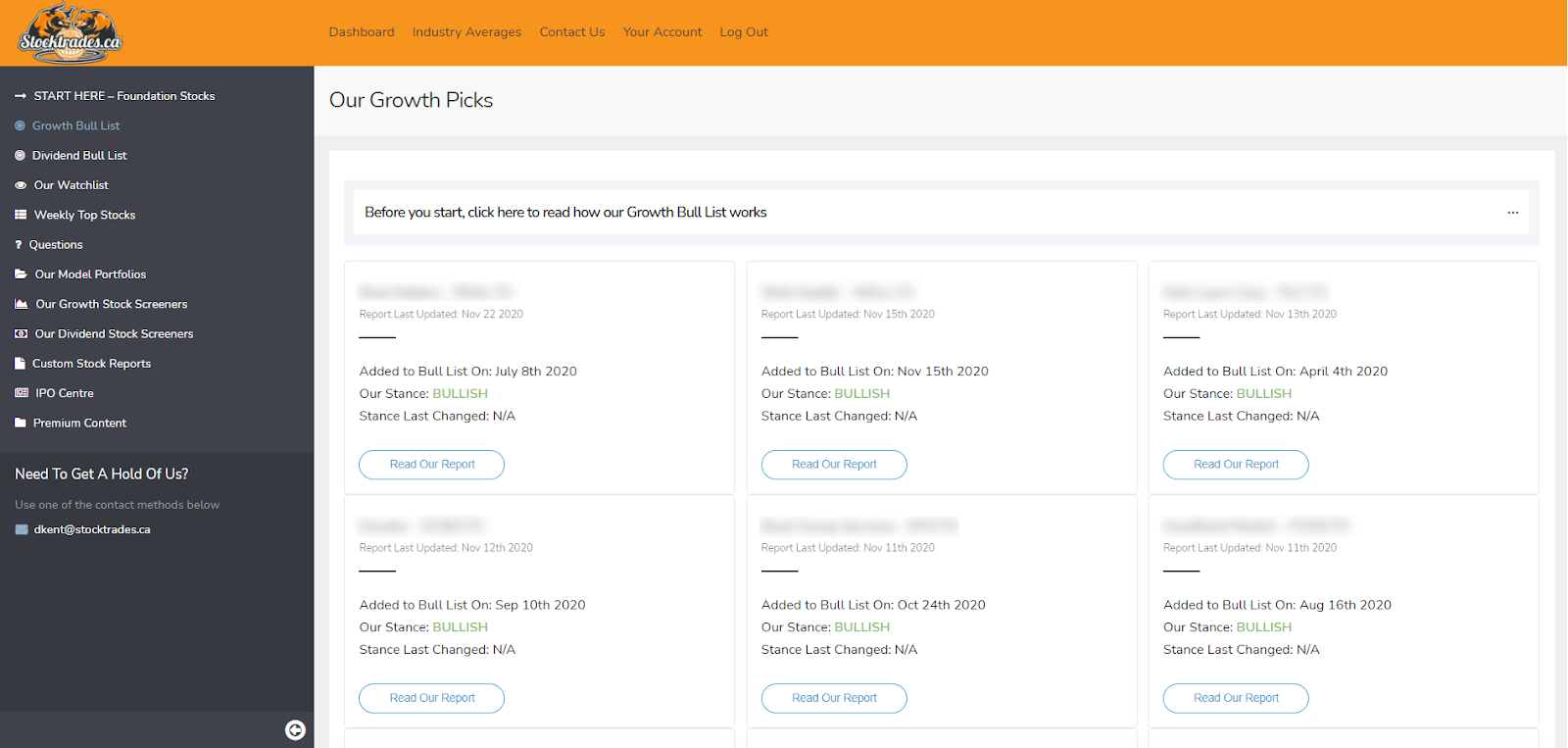
Stock Trades presents their leading picks as “Bull Lists,” organized into a Growth List and a Dividend List.
Monthly, they incorporate two additional TSX-listed stocks, one focusing on growth and the other on income. Notably, The Motley Fool charges extra for their income stock recommendations, which is a distinct advantage of Stock Trades.
The rationale and rationale for their selections are transparently communicated.
Stocks on the Growth Bull List are recognized for strong growth potential, while those on the Dividend Bull List cater to income investors.
Contrary to The Fool’s static recommendations, Stock Trades provides diligent updates, refreshing reports quarterly, shortly after the release of quarterly results.
I was impressed to receive an update regarding a stock they decided to remove from their list due to a price surge, showcasing their confidence in maintained recommendations.
The clear structure of both Bull List categories makes the information accessible for both seasoned and novice investors, while the underlying investment rationale is easily understood.
Each report further benefits from their unique ranking system, eliminating ambiguity about the companies on the Bull List—they genuinely believe in their long-term growth.
Nevertheless, Stock Trades lacks a visible performance tracker for their Bull List picks.
Though they keep members informed through monthly updates, the performance data isn’t easily navigable on the site itself.
Verdict: Stock Trades wins here by a narrow margin—both platforms exhibit similar performance metrics against the TSX Index, and their results are both transparent.
However, The Motley Fool employs a slightly different strategy by frequently doubling down on their poor-performing stocks, potentially creating a false impression of growth, when in reality, the stock might remain a negative performer since its initial mention.
Conversely, Stock Trades holds on to their picks indefinitely, tracking them regardless of shifts in price or removals from their lists.
Both platforms feature two recommendations monthly, with solid research backing each strategy. But why does Stock Trades hold the advantage?
Two main reasons. Firstly, Stock Trades’ reports are more engaging and cater to investors at various levels of experience.
More crucially, Stock Trades prioritizes quarterly updates, rendering the information dynamic and eliminating uncertainty about which stocks present current opportunities.
Question and Answer Segment
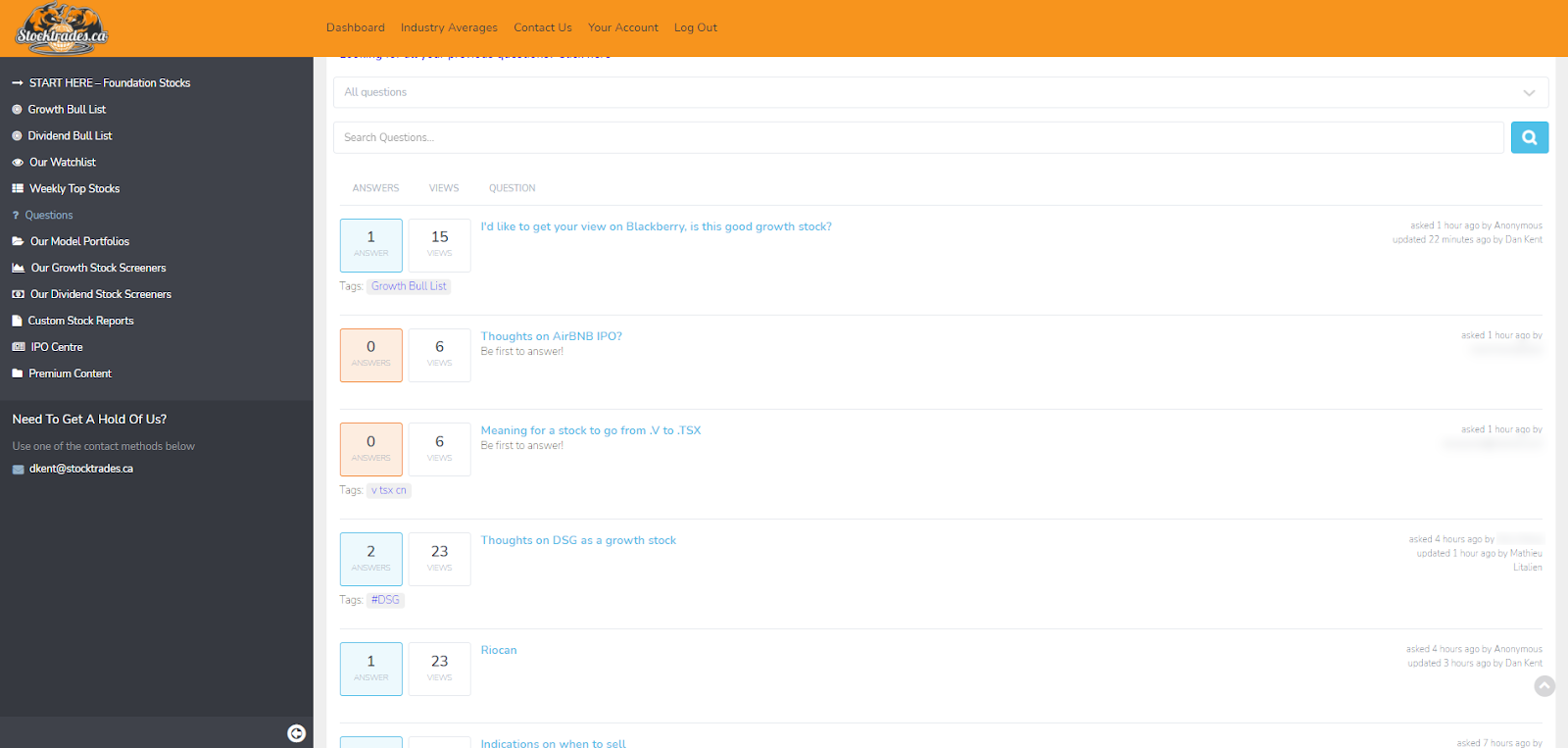
I was not surprised to find that both platforms include a Q&A section for member inquiries.
However, the quality of the Q&A offerings significantly differs.
While The Fool does have an active forum, many responses come from fellow members, and it can often take days—or longer—to receive answers from the Fool’s team.
In contrast, I’ve never waited more than 24 hours for a reply from either Mat or Dan at Stock Trades. Most answers provided exceeded the initial questions posed by members.
One observation was that Stock Trades’ Q&A does not facilitate much member-to-member interaction, which I consider a positive aspect.
While both platforms host relatively experienced investors, if I’m paying for an investment service, I prefer insights from the experts behind the platform.
In my view, Stock Trades Premium’s Q&A section far outperforms that of The Motley Fool. In fact, I would argue that the quality of this service could easily justify the subscription price.
The only reason I don’t rate it a perfect 5/5 is due to some navigation difficulties; several essential actions, such as back, forward, and edit buttons, are confined to the website itself. Clicking the back button in the browser does not work, so it requires some adjustment.
Where the Similar Features End
Aside from offering stock recommendations and a Q&A aspect, those are essentially the only shared features between The Motley Fool and Stock Trades Premium. Although they may seem similar, clearly, the execution differs significantly.
Now, let’s turn to the features that set Stock Trades Premium apart.
And there are quite a few.
Stock Trades’ Dividend Safety Screener
I found this tool immensely valuable, particularly during a time when dividend cuts surged within the market. Stock Trades features an in-browser stock screener that assesses the strength of a company’s dividend, assigning them grades between 0-5, with weekly updates.
These tables are easy to sort and can be viewed on both mobile and desktop devices (though slightly cumbersome on mobile). From a single glance, I can access information on dividend growth streaks, growth rates, and payout ratios.
Stock Trades’ Growth Stock Screener
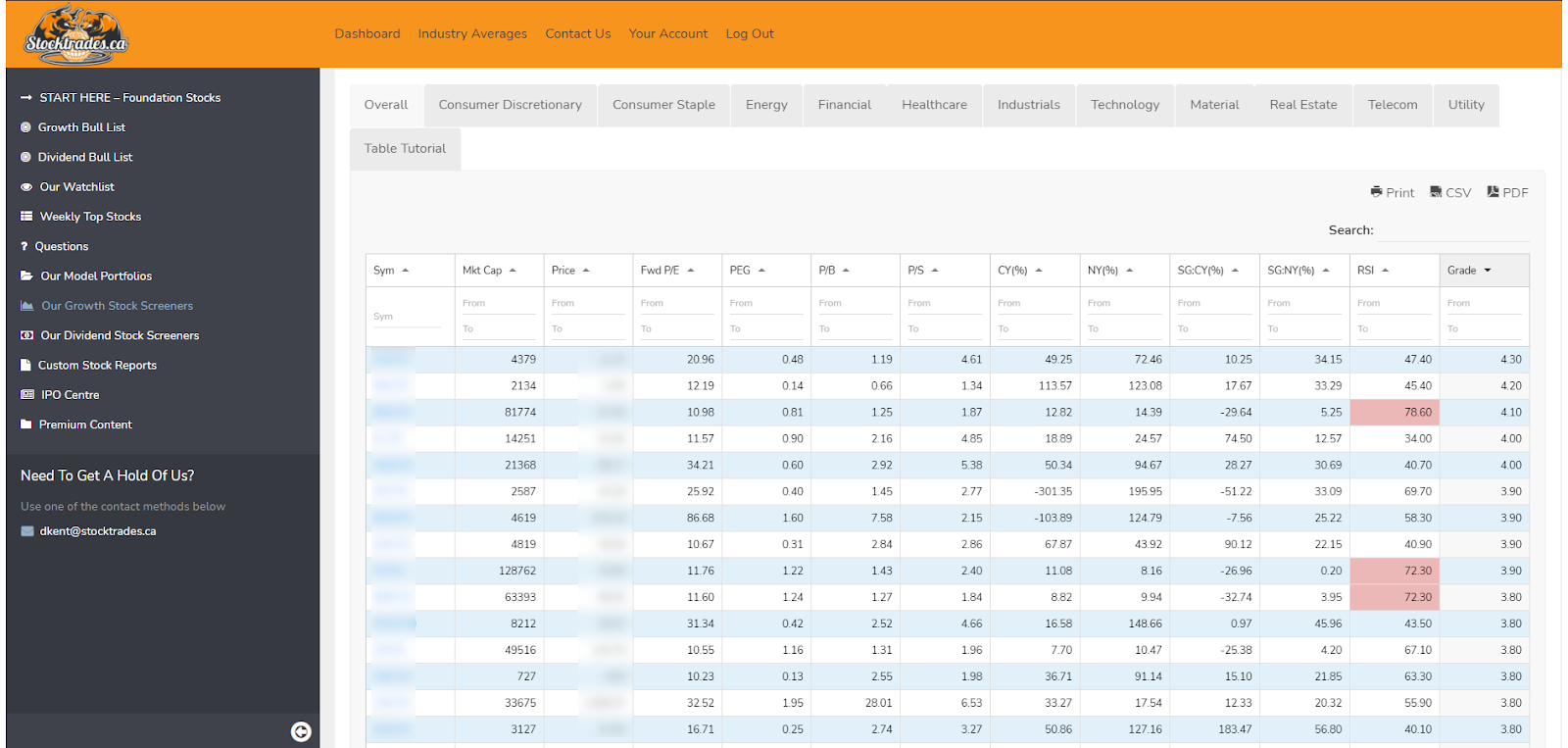
They refer to their growth stock screener as the essential part of their service, as it ranks Canadian stocks based on anticipated growth prospects.
This screener evaluates stocks based on safety, growth potential, and valuation, providing weekly rankings.
Additionally, they consistently communicate the highlights from the screener through email. You won’t lack communication from Stock Trades.
Remarkably, their screener has outperformed the TSX index in over 83% of the tracked weeks, a claim I confirmed through their readily available data.
Custom Stock Research on Request
I was genuinely astonished that they provide this service; you can request a thorough report from the Stock Trades team included with your membership—one report per month.
The report I requested arrived within four business days and matched the detail found in a Bull List report. All reports generated are accessible to every member.
Nine Model Portfolios
Though I haven’t personally monitored Stock Trades’ model portfolios, it is evident they are performing impressively. They offer nine diverse portfolios, tailored for different age groups and risk levels.
Currently, all nine portfolios have surpassed the TSX’s performance since inception, with some registering over 100% gains since late 2018—quite an achievement amidst a market downturn.
IPO Centre
This new feature highlights significant IPOs in Canada, offering news, stock reports, and ongoing Q&A regarding these offerings.
They also invest in these IPOs themselves, transparently stating that participants should only use capital they can afford to lose. Although IPOs don’t appear on their Bull Lists due to the inherent risks, it’s a fascinating feature nonetheless.
Marketing and Upsells
This element is crucial for me. When I pay for a service like this, I expect full access to the platform’s offerings.
Stock Trades operates transparently regarding marketing. Upon signing up, you receive everything promised on the platform—no upselling to pricier options once you’re in.
In contrast, after a few days with Stock Advisor Canada, I began receiving various upsell offers for pricier platforms that touted “more explosive stocks.”
The issue here is that they prematurely led me to believe I’d be accessing the most explosive opportunities at my original price.
Motley Fool creates a “get rich quick” impression in much of their material and appeals to both potential and existing members by suggesting that a small additional fee will pave the way to riches.
Stock Trades distinctly avoids any such pressure.
In fact, after subscribing to Premium, all I received were constructive emails regarding platform navigation, helpful tips, newly available stocks, and strategies—everything pertinent to their Premium offering.
Pricing
Let’s discuss pricing, an essential consideration for selecting an investment platform.
A platform needs to justify its cost through performance and support your investment strategy, or otherwise, you might as well hand your money to a fund manager.
Stock Trades Premium is priced at $249.99 per year, but I managed to secure an initial 30% discount, bringing my cost to approximately $175. Stock Trades guarantees that the sign-up price will remain unchanged, even if they decide to increase fees in the future.
Notably, the company raised its price from $199.99 to $249.99 last October, meaning those who subscribed before that date are locked in at the previous rate.
Conversely, The Motley Fool’s pricing model is rather confusing. I was bombarded with various promotions prior to signing up, suggesting that discounts would only last for a day.
Typically, they offer the service for $99 for the first year, claiming it’s a $200 discount—which misleads you into believing the service typically costs $299 annually.
In reality, the actual cost is just $199, making their pricing deceptive.
In summary, the additional $50 for Stock Trades Premium is well worth it, especially given the range of unique features offered. However, I’ll conclude with a tie in terms of affordability for both platforms.
Final Verdict: Stock Advisor Canada vs. Stock Trades Premium
Both services present solid options for long-term investors who may not have the time or expertise to conduct individual research or require extra tools.
However, I give a significant advantage to Stock Trades. While The Motley Fool focuses primarily on stock picking, Stock Trades Premium serves as a comprehensive investment platform, and I find myself logging in multiple times each week to utilize its tools for enhancing my portfolio.
Conversely, my engagement with The Motley Fool essentially amounts to reading their emailed stock selections. They don’t offer much beyond that.
The information on Stock Trades Premium is consistently updated, allowing me a greater level of confidence compared to The Fool. I have encountered Stock Advisor Canada reports that date back over a year, while the oldest report from Stock Trades will be at maximum three months old.
While Stock Trades Premium may cost $50 more annually, the difference is easily warranted by the wealth of features available.
Taking into account The Motley Fool’s other services, which impose additional subscription fees for dividend picks, IPO analysis, and model portfolios, one would easily accumulate thousands in charges with The Motley Fool.
Stock Trades emerged to address the void in quality Canadian stock insights—a space historically occupied by platforms like The Motley Fool.
In my opinion, they’re doing an exceptional job. If I were to choose just one of these platforms for renewal next year, it would undoubtedly be Stock Trades Premium.